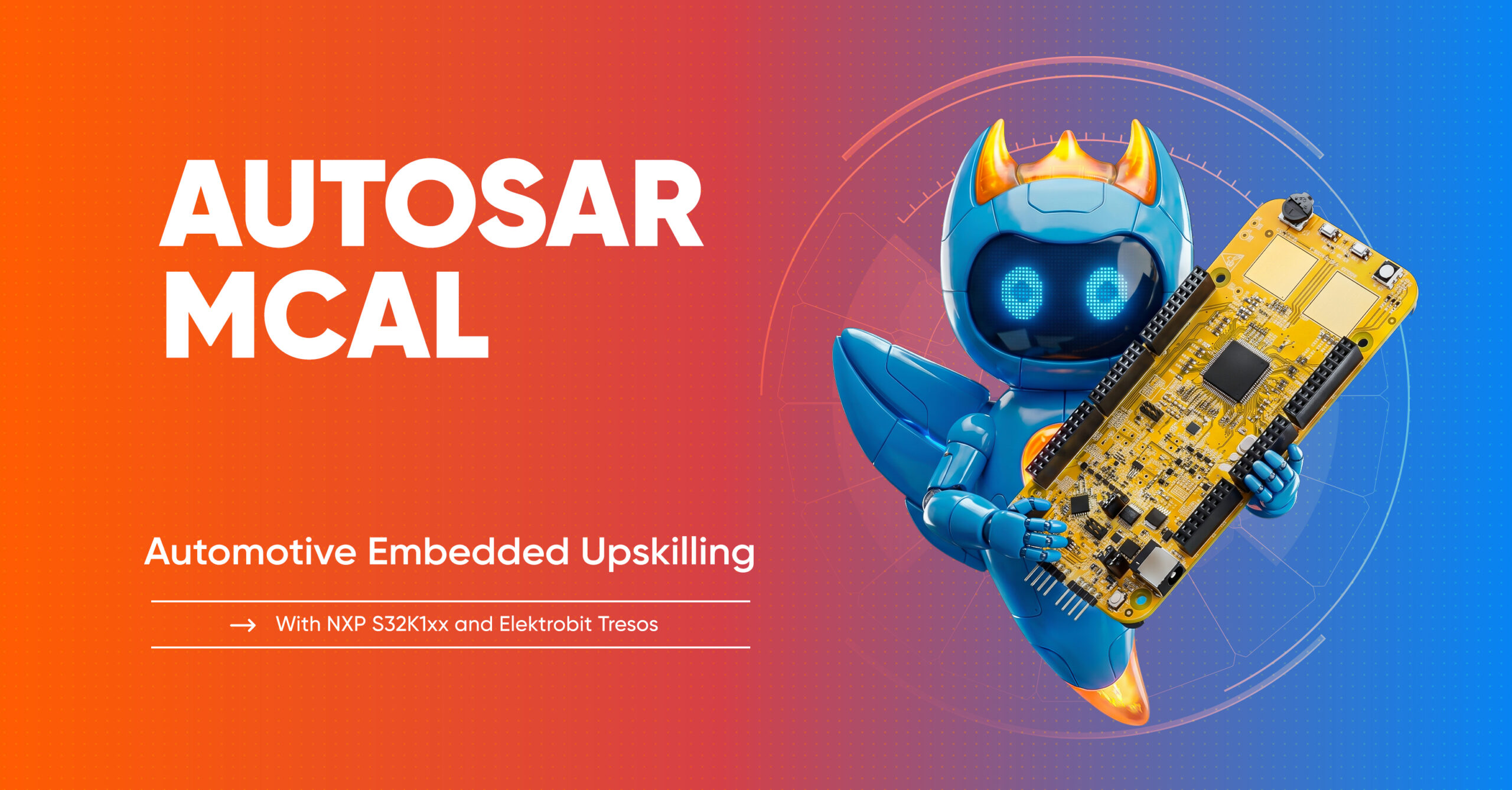
Straight from our bootcamp comes our first AUTOSAR training, focused on the MCAL layer. Through this training, you will learn to configure various microcontroller peripherals using Tresos. In addition to understanding the characteristics of these peripherals, the most crucial aspect is grasping the concepts that AUTOSAR introduces for their configuration.
This isn’t a diploma, nor is it merely a course; it’s an Upskilling Training.
Course Content
First week: Introduction to AUTOSAR MCAL and EB Tresos | Port Driver | Dio Driver
Acquire the professional skill to read complex AUTOSAR and microcontroller documentation, translating technical requirements into precise configurations inside Elektrobit Tresos.
Second week: Gpt Driver | Platform Driver
AUTOSAR handles a specification for utilizing any general-purpose timer for time periods, and it’s essential to know how to configure them. We will review the concept of interrupts and how to use them in AUTOSAR, as well as incorporate them with notifications in the GPT driver.
Third week: DET module | ADC Driver
Accelerate your debugging workflow by mastering the Development Error Tracer (DET) module, utilizing a custom pseudo-printf to pinpoint and trace configuration errors instantly.
You will get the full potential of the Analog-to-Digital Converter (ADC), which is one of the industry’s most critical peripherals, by managing real hardware data channels and group configurations mapped to physical board potentiometers.
Fourth week: SPI Driver | PWM Driver
SPI and PWM are straightforward on bare metal, but AUTOSAR completely redefines them. This week is dedicated to breaking down and mastering high-level concepts required by Tier-1 automotive companies.
You will gain concrete, hands-on experience handling complex data structures such as Jobs, Sequences, and Channels inside the standard SPI stack.
Fifth week: CAN driver | CANTrcv Driver
Get into the absolute heart of automotive networking. You will configure the low-level CANDrv and its corresponding CANTrcv from scratch, reviewing the entire production-grade CAN stack.
You will master production-critical concepts, including time quanta, identifier filtering, frame parsing, and data formats (.dbc), alongside essential AUTOSAR network layers like SDU, PDU, and Hardware Object Handlers.
Final Project: The final challenge
You will design, develop, and integrate a comprehensive parallel software project from scratch, forcing all configured MCAL peripherals to execute and communicate simultaneously on the target hardware.
For more information:
Requirements
- Laptop
- Experience in Software development in C
Tools
- NXP S32K1xx and Elektrobit Tresos
- Modular expansion board (Includes Alphanumeric LCD, EEPROM, LEDs, buttons, and CAN)
Duration
- Duration of the upskilling: 6 weeks
- Dedication: 10 hours per week
- Session with instructor: 2 remote sessions per week (1 hour each)
- Independent activities: 6 hours per week for assigned practical tasks.
Free
Self-paced learning with limited access.
Free
Limited access to course content using Embedded House
Complete AUTOSAR development environment setup
Professional
Mentored with a hardware kit.
$17,400 MXN
Full access to the course content
Dev kit included
Weekly group mentorship
Badge and Certificate of Completion
Enterprise
Custom training for engineering teams.
Custom
Full access to the course content
Custom driver modules
Dedicated support